
Making the Right Choice for Long-Term Spine Health
As a spine surgeon, one of the most common questions you hear from patients is, “Do I really need surgery?”
It’s a profound question that deserves careful consideration. While surgery is rarely the first answer, there are clear situations when it offers the best path to long-term wellness and a better quality of life.
Understanding Your Options
The decision to undergo spine surgery shouldn’t be made lightly. Today’s medical landscape offers many treatment options, from physical therapy to medication management. However, there may come a point when non-surgical treatments no longer provide adequate relief. Research shows that prolonged delays in necessary surgical intervention can lead to poorer outcomes in certain spine conditions.1
The Evolution of Spine Care
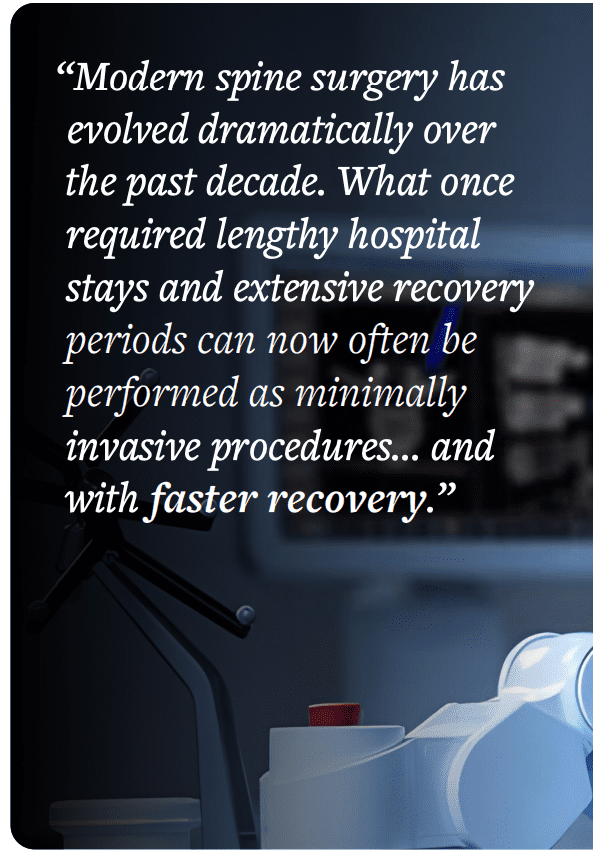
Modern spine surgery has evolved dramatically over the past decade. What once required lengthy hospital stays and extensive recovery periods can now often be performed as minimally invasive procedures with enhanced recovery protocols.2,3 This evolution has changed how we think about surgical timing and patient selection.
Recognizing When Surgery May Be Needed
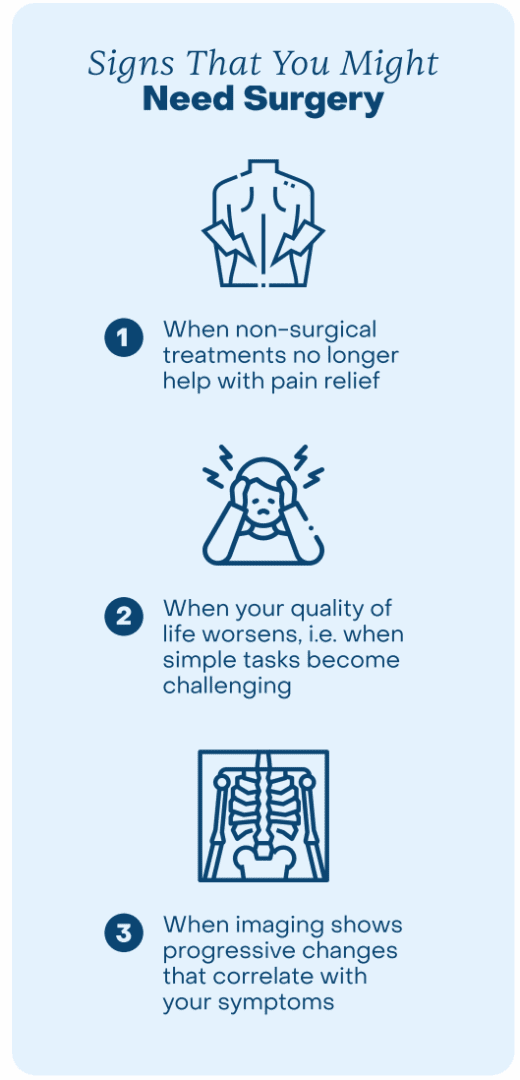
The clearest sign that surgery might be necessary is when non-surgical treatments no longer help. If you’ve diligently tried physical therapy, medications, lifestyle modifications, or more without lasting relief, it’s time to have a serious conversation about surgical options. This is especially true when imaging shows progressive structural changes that correlate with your symptoms.
The impact on your daily life is another crucial indicator. When simple tasks become challenging, work performance suffers, and you’re missing out on important life events, these aren’t just inconveniences, they’re signs that your quality of life is significantly compromised. Consistent sleep disruption and decreased activity levels can also often signal that it’s time to consider more definitive treatment options. These secondary effects of living with symptoms from a spinal condition can begin to cause negative effects on your overall health as well.
The Critical Role of Pain Management
Pain medication dependency is a serious concern in spine care. Recent research has shown that patients who undergo appropriate surgical intervention earlier in their treatment course have significantly lower rates of long-term opioid use compared to those who delay surgery.4 While pain medications play an important role in management, they’re not intended as a long-term solution. Surgery, when appropriate, can address the root cause of pain rather than merely masking symptoms.
Modern Surgical Advances
Today’s spine surgery has been transformed by technological advances. Minimally invasive approaches now allow for smaller incisions and faster recovery. Advanced imaging guidance ensures precise surgical navigation, while enhanced recovery protocols help patients return to normal activities sooner. Robot-assisted procedures and artificial intelligence-assisted surgical planning have further improved our ability to achieve consistent, positive outcomes.
Understanding Recovery
The recovery journey is as important as the surgery itself. Modern approaches begin before the operation with structured pre-habilitation programs. After surgery, clear milestones guide your progress through physical therapy, while comprehensive pain management strategies minimize the need for opioids. Regular follow-up ensures proper healing and individualized return-to-activity guidelines help you safely resume normal activities.
Making Your Decision
The right time for surgery is highly personal. Consider how your condition affects your daily life, work, and relationships, and whether or not you are using opioids to mask the pain. Think about your overall health status and available support system.
Most importantly, have an open dialogue with your surgical team about expectations, recovery requirements, and timing.
If you’re considering surgery, start by noting how your symptoms affect your daily activities, what treatments you’ve tried, and their effectiveness. Prepare specific questions about surgical options and recovery expectations. Understanding the full scope of surgery and the process that follows will help you make an informed decision.
Looking Forward
Successful spine surgery is about more than just treating pain, it is about restoring your quality of life. When conservative measures fall short, surgery can offer a path to lasting relief. The key is to make this decision at the right time for you, with full understanding and appropriate expectations.
The most successful outcomes come from a true partnership between you and your surgical team in order to create the best opportunity for success and a return to an active, fulfilling life.
References:
1 Hamilton T, Bartlett S, Deshpande N, et al. Association of prolonged symptom duration with poor outcomes in lumbar spine surgery: a Michigan Spine Surgery Improvement Collaborative study. J Neurosurg Spine. 2023;39(4):452-461. doi:10.3171/2023.5.SPINE23249.
2 Mummaneni PV, Bess S, Fu K, et al. State of the art advances in minimally invasive surgery for adult spinal deformity. Spine Deformity. 2020;8(6):1143-1158. doi:10.1007/s43390-020-00180-8.
3 Choi JU, Kee TH, Lee DH, et al. Enhanced recovery after surgery protocols in one- or two-level posterior lumbar fusion: improving postoperative outcomes. Journal of Clinical Medicine. 2024;13(20):6285.
4 Zhou Z, Jin MC, Jensen MR, et al. Opioid usage in lumbar disc herniation patients with nonsurgical, early surgical, and late surgical treatments. World Neurosurgery. 2023;173. doi:10.1016/j.wneu.2023.02.029. PMID: 36775237.